Can leather made up of mushrooms change the way we think, wear & consume fashion? Recently, scientists have developed a new kind of vegan leather manufactured completely from the mushroom root that looks, feels, and even smells like genuine leather.
Animal leather, as one of the world’s most purchased products, is the key to an $80 billion industry. Though, the creation of animal leather needs the raising of animals, associated CO2 emissions, and toxic chemicals. The finished material manufactured from animal leather is always irritating animal rights activists, environmentalists, and even fashion designers. Now, fortunately, mushroom leather has the solution to all or any of these problems. Let’s discuss in detail:
What is Mushroom Leather?
- It’s a vegan-compatible substance used as an environmentally friendly & sustainable alternative to animal leather. Mushroom leather is manufactured from mycelium (the vegetative part of a fungus). A fungus or fungi-plural is any member of the group of Eukaryotic organisms.
- Eukaryotic organisms contain microorganisms like yeasts and molds, as well as mushrooms. Fungi, different from the other life forms, have their own kingdoms on this planet, such as the kingdoms of plants and animals. For that, mushrooms have unique characteristics.
How is Mushroom Leather Made?
- The innovative idea of creating leather-like material from mushrooms goes back to 2012. Reported first by FastCompany, the fabric is named Mylo and it’s made up of mycelium -the root-like part of the mushrooms. This material is that the creation of Bolt Threads, a materials solution company that’s looking across natural and sustainable materials.
- They teamed up with a corporation that grows mycelium indoors in stacked trays. The rooms are climate controlled which simulates conditions that this organism thrives in, in the forest. The fungi grow well on sawdust- essentially sourced from the wood industry and once fully grown, mycelium looks almost like a marshmallow layer within the tray.
- This is then processed with a set of proprietary steps that’s confidential. After this, the fabric goes to the tannery, a bit like regular leather. The company has partnered with tanneries that focuses on sustainability and uses a method that removes toxic chemicals such as chromium. But since it is not an actual animal hide, it also needs quite a little processing, to begin with.
- As of now, the corporate has produced over 5000 iterations of the fabric, the ultimate version gets the classic leather texture embossed, making it tough to differentiate from the original thing. As per researchers, the feel is a lot more natural and unlike plastic or synthetic alternatives.
Production Process
The basic material of mushroom leather is Mycelium. Mycelium is the underground root structure of mushrooms. It grows as a tiny thread that forms wide areas under the forest floor.
The mycelium is the vegetative part of a fungus or a fungal bacterial colony consisting of a mass of branched filamentous hyphae. Mycelial fungus colonies occur in and on soils and many other substrates. When two compatible homokaryotic mycelia combine to form a dikaryotic mycelium, this mycelium can form fruiting bodies like mushrooms. Through the mycelium, a fungus absorbs nutrients from its environment. This happens in a two-step process. First, the hyphae secrete germs into the food source, which decompose.
Mushroom leather grows from mycelial cells, which are grown through optimal growth conditions to produce a supple, sustainable material that could replace animal leather. Basically the mushrooms get fed by bio-substrates like cellulose and grow. All in all, mycelium is a tissue-like construct that can be bred quickly and efficiently. It is possible to produce different shapes, sizes and widths. This is comparatively not the case with animal leather.
How Sustainable is Mushroom Leather?
- The entire manufacturing process of mushroom leather fits in the spirit of the circular economy and it’s fully sustainable as this natural fiber is biodegradable at the end of its life cycle. Apart from this, at the end of the entire process, the released organic waste streams like agricultural waste, are valorized.
- Also, such kind of leather alternative can lessen the necessity for industrial animal agriculture, the leading supplier of animal leather for fashion.
- Mushroom leather has a positive environmental impact that goes beyond replacing animal leather and synthetic leather- solving the plastic pollution problem as well.
- Mushroom leather is 100% sustainable, biodegradable and no chemicals are used in the coloring process. Compared to animal leather, where tons of chemicals are used in the coloring process. Poor people and also kids working in the manufactures are exposed to toxic chemicals and partly work barefoot in the chemicals, have no safety equipment etc.
- Mushroom leather takes 2 weeks to grow to the size of a standard cowhide. For example, mushroom leather grows 70-80 times faster than animal leather, which needs about 3 years on average. If one additionally considers that only 30% of the animal’s skin is used and 100% of mushroom leather can be used after growing it.
- Mushroom leather can be worn very well on the skin and does not cause irritation. Completely explainable when you consider that mushrooms have been used in Chinese medicine for thousands of years to cure skin diseases, amongst other things.
- Last and most important, mushroom leather is 100% vegan and no animals are killed. This material could really create a change in this industry.
Mushroom leather is strong, flexible and durable, just like traditional leathers. It is also waterproof. And since it’s made of natural fibers, it breathes and feels like leather.
Leather is uniquely customizable. Can incorporate textures and other features directly into the material. And unlike animal skins, materials can grow to any size and shape.
Is Mushroom Leather Beneficial for Human Skin?
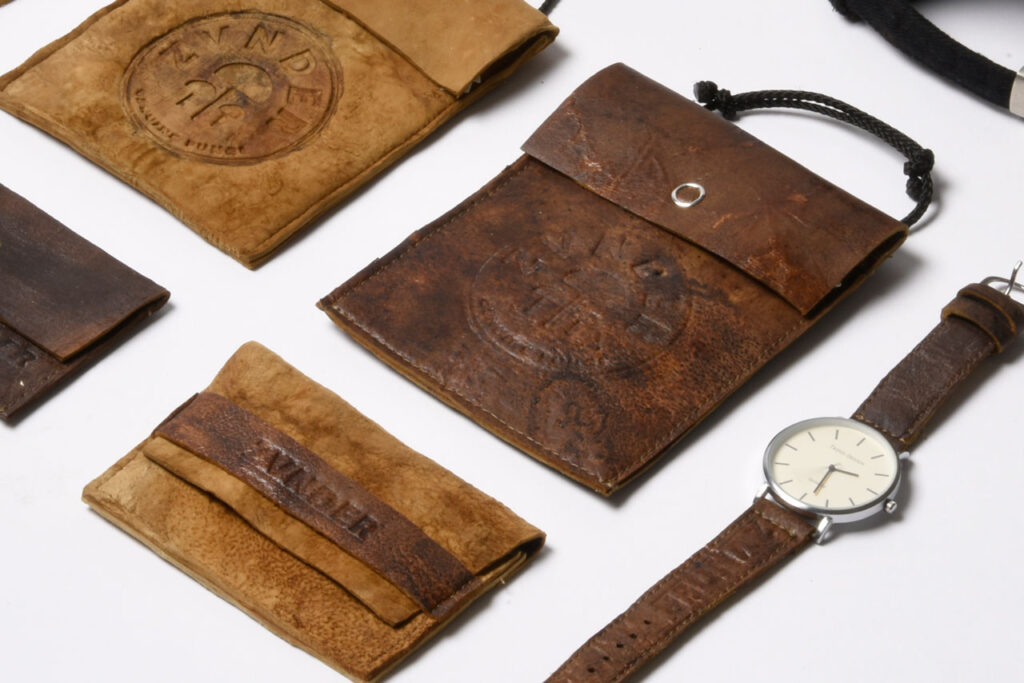
- Mushroom leather is a lightweight and very flexible material, which makes it practical for a wide range of products. Tests conducted by Zvnder, a German company specialized in mushroom leather accessories highlights that: “When in direct contact with the skin, mushroom leather shoes have improved athlete’s foot condition. Even as watch straps, this material prevents skin irritation in people suffering from eczema.” Also, given its highly absorbent natural characteristic, mushroom leather can absorb a lot of moisture.
- Therefore, shoes made from mushroom leather don’t need harmful chemicals sprays to remove bad odors anymore. Another important factor for human skin is the material’s unique capacity for holding a high amount of air. That’s why the products made up of this material are not only unusually light but also have an excellent insulating effect.
Comparison to Animal Leather
Here is a direct comparison of mushroom leather to cow leather.
Mushroom leather
- 100% bio-degradable
- no chemicals in colouring process
- less water
- grows 70 – 80 times faster (cow size in 2 Weeks)
- wearable on skin
- no animals harmed
Animal leather
- animals get killed
- tons of chemicals
- uses 50% of water supply
- uses 30% of earths land mass
- produces 18% of earths greenhouse gas emissions
- Only 30% of a hide gets turned into leather (rest thrown away)
- human life violations (chemicals in production process etc.)
It is very well suited for dark leather goods, but other fashionable accessories just look fancier with other leather alternatives like Piñatex. Piñatex is made from recycled pineapples leaves.
To conclude, I would like to say that the possibilities of what we can create with mushroom leather are endless. Although mushroom leather is still a new material, it needs time to gain acceptance, reputation & mass consumption.